If you’ve spoken to even one clothing manufacturer, you’ve probably already heard the term MOQ. It comes up almost immediately in supplier conversations, and for good reason. It’s one of the first factors that determines whether a manufacturer is even a realistic option for your brand. Yet a lot of new brand owners don’t fully understand what it means or why it exists in the first place, which can lead to confusion or, worse, a production commitment they weren’t ready for.
Let’s break down what MOQ actually means and why it plays such a big role in how you plan your business.
What MOQ actually means
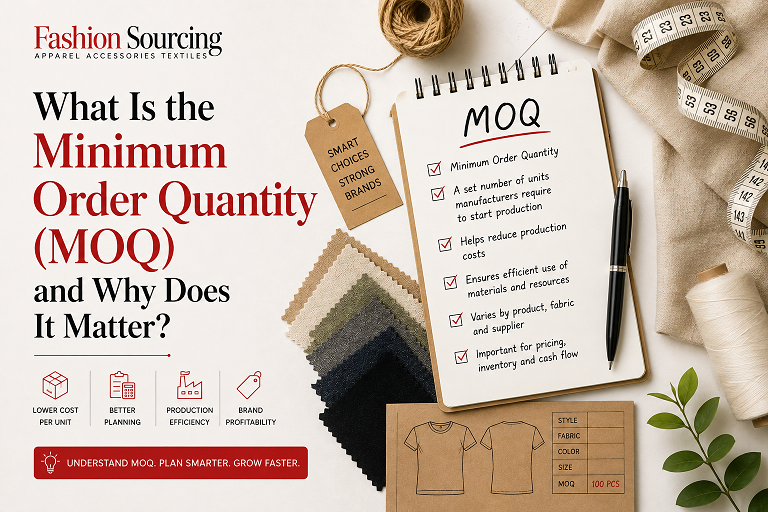
MOQ stands for Minimum Order Quantity. It’s the smallest number of units a manufacturer agrees to produce in a single order, whether that’s per style, per color, or per fabric type, depending on how the factory structures it. If a supplier sets an MOQ of 300 pieces per style, that means you can’t order less than that, even if you only wanted to test the market with 50 units first.
Why manufacturers set an MOQ in the first place
- Setting up a production line, cutting fabric, and preparing machinery takes time and resources, regardless of order size
- Bulk buying fabric and trims is more cost-effective for the factory, so smaller orders often aren’t financially worthwhile for them
- Labor and machine time need to be planned in advance, and small orders can disrupt scheduling for larger clients
- Many factories work with tiered production lines, meaning very small runs simply don’t fit their standard workflow
Understanding this helps explain why MOQs exist, rather than feeling like an arbitrary hurdle designed to make things harder for small brands.
Why MOQ matters for your business
MOQ isn’t just a production detail, it directly affects your budget, storage needs, and cash flow. Committing to a high MOQ means tying up more money upfront, and potentially sitting on inventory that takes months to sell through. On the other hand, a low MOQ gives you flexibility to test new designs without a huge financial risk, though it might come with a higher per-unit cost.
Here’s what to weigh when evaluating MOQs:
- How confident are you in the demand for this particular style
- Whether you have enough storage space for unsold inventory
- How much capital you’re comfortable investing before generating sales
- Whether the manufacturer offers different MOQs for different fabric types or print methods
How to work with MOQ as a new or small brand
If a factory’s MOQ feels too high for where your brand currently stands, you’re not out of options. Some manufacturers offer lower MOQs for an additional cost per unit, which can still make sense if you’re testing a new product line. Others may allow you to combine multiple colorways or sizes within the same style to hit the required quantity, which is often more manageable than committing to one single color in bulk.
It’s also worth building a relationship with your manufacturer over time. As you place repeat orders and prove consistency, some factories become more flexible with future MOQ requirements.
Finding a manufacturer whose MOQ actually matches your business stage can save you a lot of financial stress early on. This is where working with a sourcing platform like Fashion Sourcing can help, since it connects brands with a range of manufacturers offering different MOQ options, rather than leaving you to filter through suppliers one by one.
At the end, MOQ isn’t something to fear, it’s simply a number to plan around. Once you understand how it works and why it exists, you can make smarter decisions about which manufacturer actually fits your brand’s current size and growth plans.